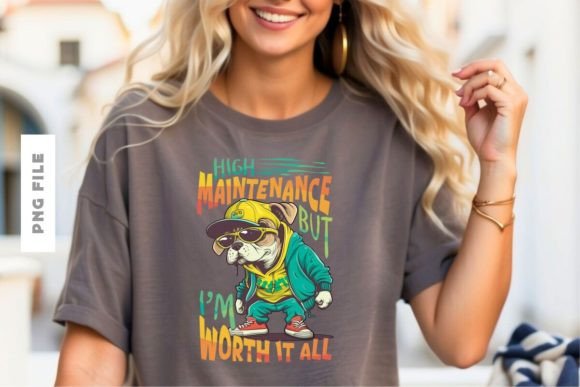
High Maintenance: The Ultimate Ready-to-Print Design File
Let's be honest: the phrase "high maintenance" usually gets a bad rap. It implies difficulty, demands, and a level of perfectionism that can be exhausting to deal with in a person. But in the world of design and branding? Being high maintenance is the goal. You don’t want "good enough" graphics for your merchandise. You want pixel-perfect, vibrant, and scalable assets that look just as good on a massive billboard as they do on a coffee mug. If you are building a clothing brand, managing a Print on Demand (POD) store, or simply looking to create merchandise that doesn't look like it was printed in a basement, you need assets that demand attention. That is exactly what we have crafted with this specific design package—a bold statement piece that requires zero compromise on quality.
Why "Ready-to-Print" Changes the Game for Entrepreneurs
If you have ever tried to prepare a design for a screen printer or a DTG (Direct to Garment) machine, you know the headache. You start with a low-res image from the internet, spend hours in Photoshop trying to remove the background, only to have the printer send it back saying the DPI is too low. It is a workflow killer. This is where the practical value of a professional-grade asset shines. We are talking about a High Maintenance T-shirt Design delivered as both PNG and PDF files, prepped at a crisp 300 DPI.
For the small business owner or the creative entrepreneur, this removes the technical barrier to entry. You don’t need to be a Photoshop wizard to get professional results. The files are structured specifically for digital printing, sublimation, and screen printing. This versatility is crucial because it allows you to pivot your business model without changing your assets. Maybe you start with screen-printed hoodies but want to move into all-over sublimation shirts next season. With a high-quality vector-ready PDF and a high-resolution PNG, the design adapts to the medium, not the other way around.
Beyond the Cotton Tee: Maximizing Your Merchandise Potential
A great design is rarely a one-trick pony. While the name suggests a specific application, the utility of a strong, graphic-heavy design extends far beyond a standard crewneck t-shirt. Think about the modern influencer or the lifestyle brand. They aren't just selling clothes; they are selling a vibe. That vibe needs to be consistent across every touchpoint.
Consider the practical applications of a design that is built to scale. Because this asset is allowed for an unlimited number of copies, it becomes the backbone of a diverse product line. You can apply this "High Maintenance" aesthetic to:
- Tote Bags: Eco-friendly canvas totes are a massive market right now. A bold graphic turns a utility item into a fashion statement.
- Posters and Wall Art: If your brand has a physical presence, or if you sell digital downloads for home decor, the PDF format ensures the design remains sharp even at large print sizes.
- Mugs and Drinkware: Sublimation printing on mugs requires high saturation and resolution. A 300 DPI file ensures the blacks are deep and the colors pop, rather than looking washed out.
- Hoodies and Sweatshirts: Often, designers size down a t-shirt graphic for a hoodie. Having a high-res master file allows you to play with scale—perhaps a massive back print or a subtle chest logo—without losing integrity.
By treating your design assets as a flexible system rather than a fixed image, you future-proof your brand. You can run a limited edition drop of posters this month and switch to tote bags next month, maintaining the same visual language without extra design costs.
The Psychology of the "High Maintenance" Aesthetic
From a branding perspective, the phrase itself carries a specific weight. It suggests luxury, exclusivity, and a refusal to settle for the ordinary. When you put this on a t-shirt, you aren't just selling a piece of cloth; you are selling an attitude. This is vital for brand recognition. Customers buy into identities. A design that screams "high maintenance" attracts a demographic that values quality, attention to detail, and perhaps a bit of sass.
This type of design works exceptionally well for brands that want to position themselves as "premium." It pairs nicely with modern typography and minimalist layouts. Imagine using this design as the hero image on a website landing page. It immediately sets a tone. It tells the visitor that this brand is confident and unapologetic. It creates an emotional hook before the customer even reads the product description.
Furthermore, the aesthetic versatility is broad. Depending on the specific artistic style of the graphic—whether it’s a gritty streetwear texture, a clean sans-serif vector, or an elegant script—it can target different sub-niches. It can be edgy for Gen Z streetwear, or chic for a millennial-focused lifestyle blog. The key is that the visual quality remains consistent across all these applications.
Technical Reliability for Mass Production
One of the biggest fears for anyone in the merchandise business is the "garbage in, garbage out" principle. You can have the best marketing strategy in the world, but if your final product looks blurry, pixelated, or poorly cropped, you lose credibility instantly.
This is why the specifications of this asset matter. The 300 DPI standard is the gold standard for print. It ensures that when the ink hits the fabric or the paper, it creates a continuous tone image rather than a visible grid of pixels. For screen printers, the separation of colors in a high-quality file makes the stencil creation process smoother, reducing setup time and costs. For DTG printers, it ensures that white ink underbases lay down correctly, allowing the design to pop on dark garments just as brightly as it does on light ones.
The inclusion of the PDF format is particularly helpful for those who might need to scale the design up for large format printing, like banners or signage. While PNGs are raster-based (made of pixels), PDFs can contain vector data, which is mathematically infinite in scalability. This means your "High Maintenance" design can literally cover a wall without breaking a sweat.
Integrating Design Assets into Your Workflow
For the content creator or marketer, efficiency is currency. Time spent fiddling with file formats is time not spent engaging with your audience or developing new products. Having a "plug-and-play" asset is a massive operational advantage.
When you download a package that is ready for digital printing and sublimation, you are essentially buying time. You can take the PNG, drop it into your mockup generator, and have a new product listing live on your Shopify or Etsy store in minutes. You can use the graphic in your Instagram stories or as a header for your email newsletter to promote the new drop. The visual consistency between your marketing materials and your physical products builds trust. When a customer sees a vibrant, high-quality image on their phone, and the physical product matches that expectation, you earn repeat business.
Ultimately, success in the creative market comes down to having the right tools and knowing how to use them. By securing high-quality, commercially licensed assets that are built for mass production, you remove the guesswork. You can focus on the creative side of your business—the storytelling, the community building, and the curation—knowing that the technical foundation of your product is solid. It’s about working smarter, not harder, and ensuring that every product you ship represents the highest standard of your brand. Good luck with your store; with the right assets, you are already ahead of the curve.